Graph Convolution Network - Part I
Embedding/Latent Space
It is a space where a list of embeddings live. The sentences with similar semantics end up closer to each other while the sentences with different semantics end up a little farther. One cannot make sense of the meaning just by looking at the embeddings as it is just a sequence of numbers. But when it is compared with other known patterns, it starts making sense.
Main Idea
Given a specific node, it aggregates the features of neighbouring nodes with it’s own and embeds them in a newer latent space. The new embeddings are the node’s features now. If a node wants to aggregate the features of nodes farther from it, the same process is repeated. Each repetition gives convolution of node one step farther.
ST-GCN
The aforementioned convolution is spatial. If we introduce time to it, we can call it temporal. Spatial aggregates the features of multiple neighbouring nodes across the graph for a single instance of time but temporal aggregates the frames of the same node across different time T.
Architecture - One piece at a time
Input
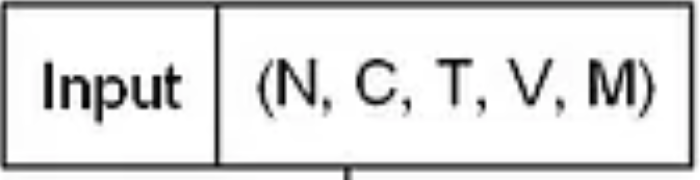
Input has 5 components:
N = Batch size(How many clips are processed at once?)
C = How many points are used to represent a node?(CoordinateX/CoordinateY/Confidence_Score) - Channel: General ML term for how many points describe one node?
T = Number of frames
V = Number of graph nodes
M = Number of skeletons in the frame(ST-GCN was designed to accomodate multiple people signing in the same frame)
Permute, View
Permute: Permute means reodering or relabeling the axes. View: View means reshaping the tensor shape often by merging.
BatchNorm1d
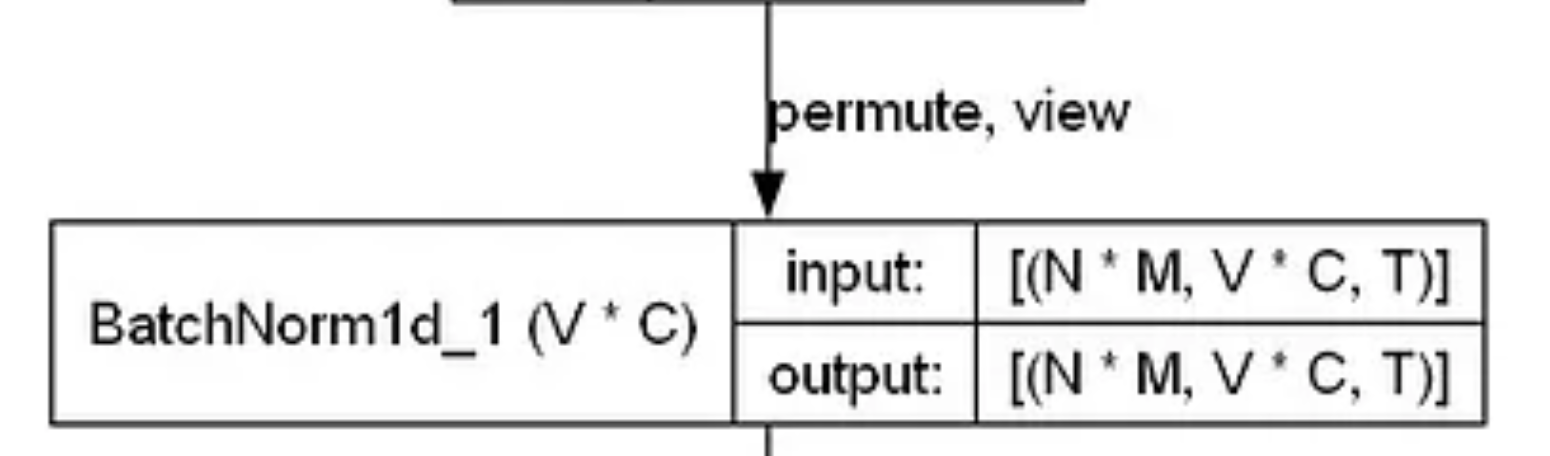
Permute changes the input into: $[(N, M, V, C, T)]$
View changes the permuted input into: $[(N*M, V*C, T)]$
Why do we need BatchNorm1d?
Real joints coordinates vary along a very large range and are quite messy. If they are fed directly into the model, it has to spend time first to figure out those scales rather than actual ranges.
Actual Operations
Goal: Mean = 0, Spread = 1
- Find the mean and subract mean from every element in the list
- Find the spread of the newly found list and divide each element by the spread
- The new obtained list is centered at 0 with mean = 0 and spread = 1.
BatchNorm1d takes the input in the format (batch, channels, length), permute and view help convert 5D tensor into the format needed.
ST-GCN Block
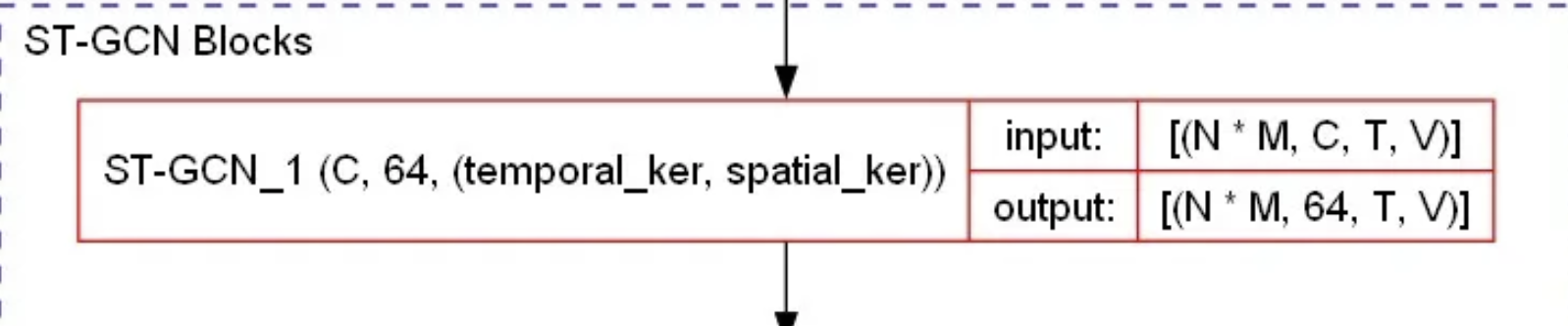
There are two new terms that we need to get familiar with in the first place. Spatial Ker: It indicates the number of relationships that exist between the nodes. Temporal Ker: It indicates the number of frames that blend together.
Zoom out
Take a sequence of pose data of the body and figure out the actual sign.