NSL
What are we trying to achieve?
A model which takes any sequence of fingerspellings, and it should give as output, the continuous signing with pauses and natural motion of hands which will be used as a synthetic dataset for the project.
What do we need for that matter?
- What each letter looks like?
- How do hands move between letters?
- Where does sign for a letter start and end?
2026-09-25 — nsl / aligner boundaries
Broke: Aligner was supposed to beat a naive baseline model which just takes equal intervals in determining the start and end of a sign but it did worse.
First Guess: I didn’t have idea about it. I just thought, “It is guessing it wrong”.
Real Cause: The real cause was the fact it assumed, that the transistion will have motion and the sign will be static but that isn’t always the case. In continuous signing, the sign is held for way short of a time and the aligner mistook the fast changes for transistion.
Boundary: In isolated letters the signs are static but for continuous signing the signs move pretty fast.
2026-10-06 - Uni-Sign Paper
Methodology
Unified Pre-training and finetuning: Preliminaries
There are 133 keypoints for the whole body but we specifically utilize 69 keypoints only: 21 for each hand, 9 for the body and 18 for the face. Each group of keypoints i has an encoder, which is composed of three-layer spatial GCN(For a single frame, it travels 3 hops across hand per say so that fingertips have information about joints several hops away). Learn more about it at GCN-PartI and GCN-PartII.
It produces an output $\mathcal{F}_{p}^r \in \mathbb{R}^{T \times N_i \times w \times C}$ where,
T = number of frames
$\mathcal{N_i}$ = Number of keypoints in group i
C = How many features represent keypoints after encoding?
i ∈ {lh, rh, b, f }
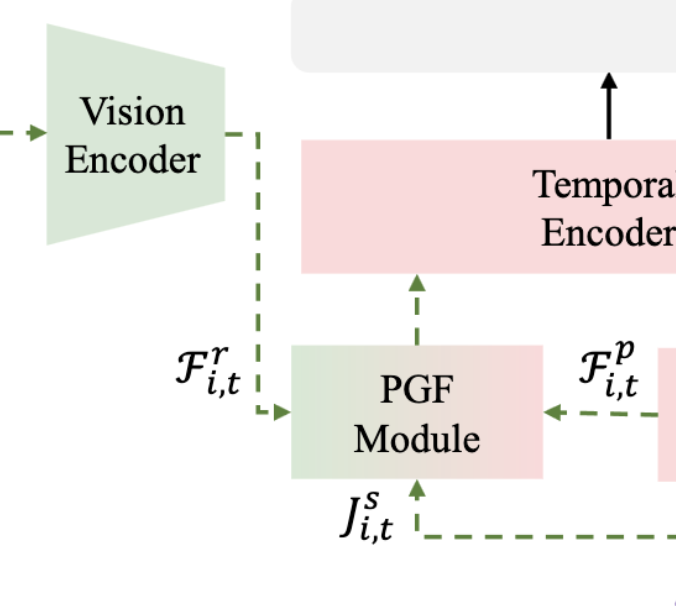
In the second part, idea of decoupling visual cues is used. Videos are cropped using keypoint coordinates and resized to 112 * 112 pixels which are processed by Vision Encoder. It gives out results $\mathcal{F}_{lh}^r \in \mathbb{R}^{T \times h \times w \times C}$ and $\mathcal{F}_{rh}^r \in \mathbb{R}^{T \times h \times w \times C}$. Then the two ouputs, $\mathcal{F}_i^p$ and $\mathcal{F}_i^r$ are fused to form $\tilde{\mathcal{F}}_i^p$. Fusion is done in order to ensure the data lost duirng posing is recovered.
Zoom out
A sequence of keypoints 133 keypoints for each frame arrive, then it is divided into 4 body parts(face, body, lh, rh) 21 points for hands, 9 for body and 18 for face by taking 69 points and discarding the other 64. It is then processed by 3 layer spatial GCN which takes each group of points and for each joint point aggregates it with the first neighbour thne the resulting to second then to third which gives the result Fpi belongs to R^(T×Ni×C) which means a tensor of 3 dimension consisting of real numbers, Fpi = pose features for gorup i T = number of frames, Ni = number of points in froup i and C = channel or the dimension of points features or the number of points used to represent a feature.
How it works?
There are two parts of it. Let’s look at one part of it first.
Pose Encoding
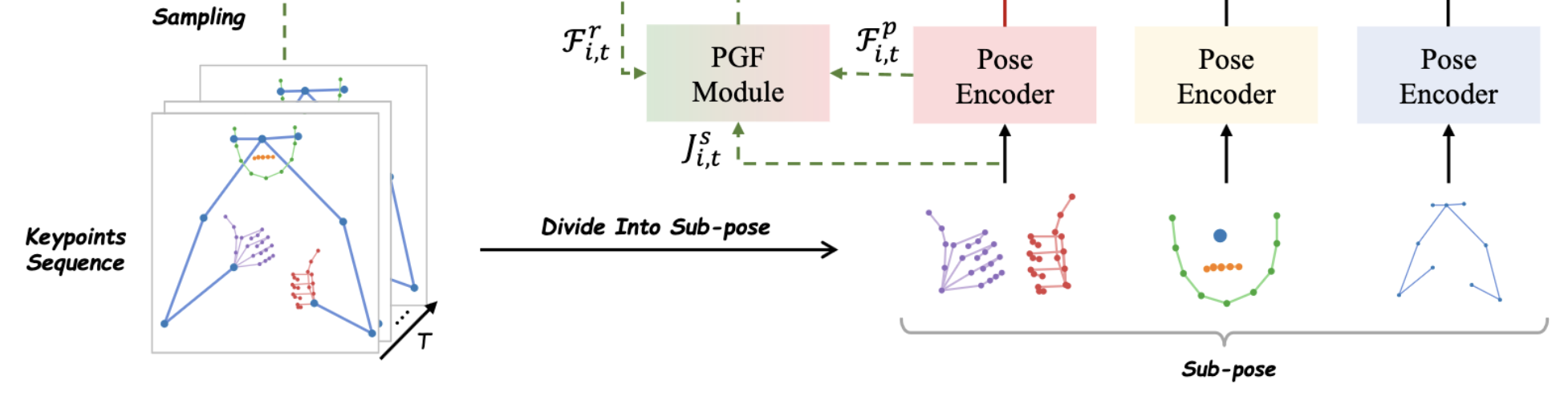
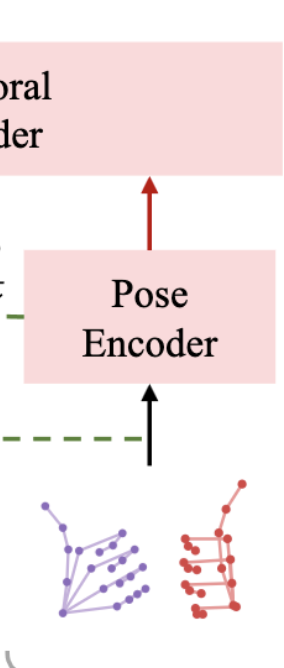
There are 133 keypoints in pose data but only 69 are taken. There are 69 sub-pose groups: 21 for each hand, 18 for the face and 9 for the body. These sub-groups are fed into each of their own PoseEncoder which is composed of three-layer spatial GCN. It gives out an ouput: $\mathcal{F}_{i}^p \in \mathbb{R}^{T \times N_i \times w \times C}$
where,
$$ \begin{aligned} T &= \text{number of frames} \\ N_i &= \text{number of keypoints in frame } i \\ C &= \text{number of values used to represent each keypoint} \end{aligned} $$Vision Encoding
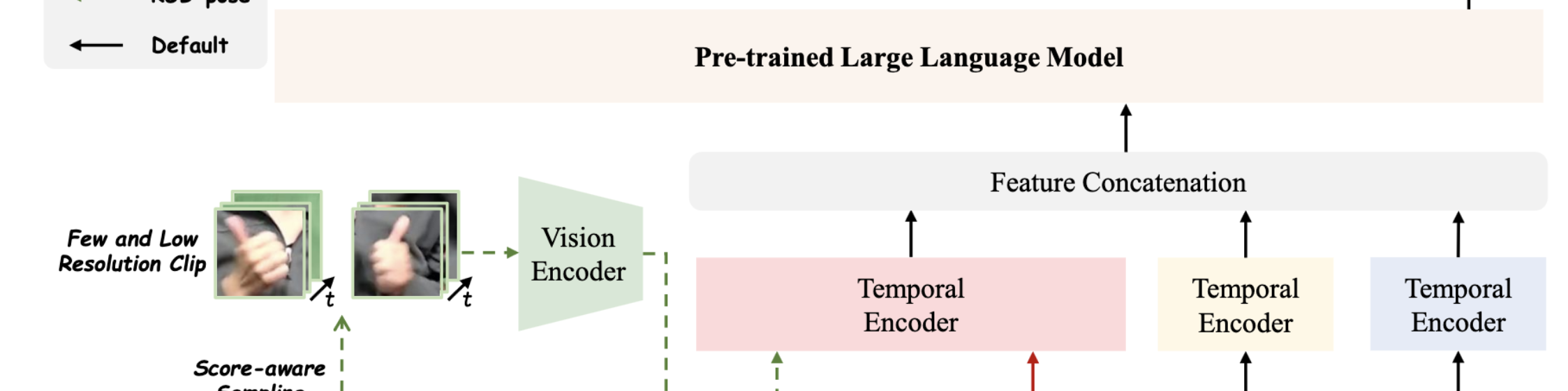
The pose encoder misses many important encodings. It occluded the hand data. So, vision encoder is used to improve on that data.
Few questions before moving on
Why only take lh and rh in consideration?
- Hand data carries the most critical information.
- Fingers, curls, twists are occluded the most.
PoseEncoder has $N_i$ only but Vision Encoder has $w, h$?
- In pose encoder, data is 2D = $w, h$
- Pose data is sparse(only 21 for hand) list of named(wrist, tip) points.
There is a mention of resizing back to 112 * 112, why do we resize?
Batch
Group of several tasks executing in parallel.
GPU is designed to perform these calculations in parallel, rather than one at a time.
Condition for Batching
The tensors need to be of same side.
Problem with pictures
Due to camera angle and distance, the cropped pictures have different sizes and resizing is necessary to make batches
I’m backkkkkkkkk
The short term temporal encoder is used in Vision Encoding which is constructed employing ST-GCN. It crops the hand data using pose coordinates. It then resizes the image to 112 * 112 size grids. It performs CNN to convolve the pixels. It then produces $\mathcal{F}_{lh}^r \in \mathbb{R}^{T \times h \times w \times C}$ and $\mathcal{F}_{rh}^r \in \mathbb{R}^{T \times h \times w \times C}$. The two features $\mathcal{F}_{i}^r$ and $\mathcal{F}_{i}^p$ are fused in order to receive $\tilde{\mathcal{F}}_i^p$. The temporal encoder is fed with ({$\tilde{\mathcal{F}}_i^p$} or $\mathcal{F}_i^p$).
$\mathcal{F}_i^p$ as input
{$\tilde{\mathcal{F}}_i^p$} as input
The temporal encoder outputs are aggregated intra-group via mean pooling layer and concatenated across all groups(face, body, hands) to get final $\mathcal{F}_{sign} \in \mathbb{R}^{T \times 4C}$ which is then fed as input into Pre-trained LLM.
Pre-training Uni-Sign
Let’s get familiar, shall we?
Generative Pre-training
Generative: Task is to predict/generate text, not classify.
Pre-training: This happens as a foundation.
Gloss text
When the signers sign the sentences or words, they don’t really consider words like ’the’, ‘is’, or any kind of verb or puntuation. The sentences are just glosses.
For example, The cat is running -> Cat, Run(Text to Gloss).
It is collectively a process where a model is trained on a specific task. For an example, we give it text and make it predict the next word, punish it based on the loss function and it adjusts it’s weights in order to get better at predicting words. With this training, it can generate text given a prompt.
A lot of researches used an intermediary step in order to predict the sign languages. They used gloss to text models in order to teach the model to recognize the sign but were actually never shown the videos. But Uni-Sign uses a different approach. LLMs are generalized upon a large amout of text data. Uni-Sign utilizes that by feeding $F_{sign}$ data by converting it’s dimension into whatever LLM takes. Basically, the model is fed with labeled data and $F_{sign}$, and given the data it has to predict what the video sign means. The labeled data is fed one token at a time. $s_{\lt u}$ stores the tokens before the current word. The loss function calculates the loss and the needful weights refactoring done using backpropagation.
$$\mathcal{L}_{lm} = - \sum_{u=1}^{U}\log\mathcal{P}(s_u | s_{ \lt u}, \mathcal{F}_{sign})$$Fine-tuning Uni-Sign
There are specific fine tuning methods tailored to each task(MLP head for ISLR, CTC loss for CSLR). But in this paper, SLU tasks(ISLR, CSLR, SLT) are fine-tuned using an unified fine-tuning paradigm by treating three tasks as a single SLT task. To construct supervision targets(ground truth to compute loss), ISLR uses action recognition, CSLR uses gloss sequence and SLT uses translated tasks. Through this method, the model which learnt robust SLU capabilities during pre-training are seamlessly transferred to downstream tasks.